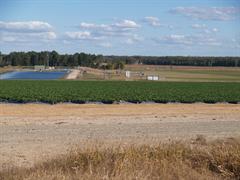
Train in both management and horticulture to work in the cropping industry
Opportunities in this industry are likely to grow rapidly over coming years. The Agri Foods Skills Council (Australia) reported an impending shortage of skilled and professional personnel at their 2007 conference in Sydney. These sentiments were repeated again by the council in 2009.
In 2015 similar concerns were being expressed as the world continued to consider the impacts of globalisation, population growth and climate change.
Secure Your Future
Develop both the skills required to manage a horticultural farm (eg. Market Garden, Orchard), and also to developing knowledge in the identification, growing, processing and marketing crops and crop related products. This course involves eight units, plus a 200 hr workplace project. These are the four core units common to all streams of this Advanced Certificate (ie. Management, Business Operations, Office Practices and Marketing), and three specialist units of study relating to crop production.
COURSE STRUCTURE
Summary
This course is comprised of:
The Modules
Core Units
Totalling 400 hours. All four of these modules must be studied and passed.
1. Office practices
Develops basic office skills covering use of equipment, communication systems (telephone, fax, etc) and office procedures such as filing, security, workplace organisations, etc.
2. Business operations
Develops knowledge of basic business operations and procedures (eg. types of businesses, financial management, business analysis, staffing, productivity, etc) and the skills to develop a 12 month business plan.
3. Management
Develops knowledge of management structures, terminology, supervision, recruitment and workplace health and safety.
4. Marketing Foundations
Develops a broad understanding of marketing and specific skills in writing advertisements, undertaking market research, developing an appropriate marketing plan and selling
 Stream Modules
The three specialist units include:
1. Outdoor Plant Production This unit provides a foundation in crop production, with the following aims:
2. Protected Plant Production Describe and evaluate the type and shape of modern growing structures
3. Another Crops Module chosen from the following options:
Fees do not include exam fees
WORK PLACE PROJECTS
This is the final requirement that you must satisfy before receiving your award. There are several ways this can be completed; ranging from work experience, to undertaking our standard workplace project modules
Modules
Note that each module in the ADVANCED CERTIFICATE APPLIED MANAGEMENT (CROPS) VBS001 is a short course in its own right, and may be studied separately.
Horticultural Careers for a Secure Future
We all know that the world is changing fast. This is evident in everyday life, in business, in industry, and in our personal lives. Almost every week we are offered new and more sophisticated technology to help us communicate or to perform common tasks. The horticulture industry too has not been exempt in this evolution; plant propagation, plant care, harvesting techniques, growing systems, the way we care for golf courses and parks and even our approach to home gardening, have all changed dramatically over recent decades. These changes will continue as new techniques and new technologies are formulated and introduced.
If you want to have a career in horticulture, you must recognise the inevitability of these changes. To have a long and sustainable career, you need to be able to adapt to change, and to excel you need to embrace and take advantage of change. To achieve this, your knowledge and skills in horticulture must be broad based. If you understand the fundamental skills needed - across all sectors of horticulture - you will be able to see opportunities as they arise and confidently move from one sector to another, throughout your career. As an example, anyone with underpinning knowledge of plant science and plant cultural practices: plant growth and identification, soil management, pruning and pest control and the associated technologies, will be able to work in landscaping for a few years, then move to turf management or nursery production and later work in crop production.
Sound, broad-based training in the fundamentals of horticulture is a good starting point for entering this industry. However, not all courses on offer will be broad enough or in-depth enough to set you up for a sustainable, lifelong career – so you need to understand the fundamentals required in horticulture (in general) and then choose a diverse course, that enables you to achieve these aims.
Scope of Horticulture is Huge
In 2009 (source FOASTAT):
- World fruit production was 635 million tonnes
- World vegetable production was 1.811 billion tonnes
- 42% of the world’s fruit and vegetable production was in China and India
- The majority of fruit and vegetable production was through large scale farms (large acreage usually using mechanised and sophisticated farming techniques).
In 2014, the price of food in America increased by as much as 10%
Some countries export more horticultural produce than they import, whereas others import more than they export. Some are strong net exporters of certain things but net importers of other things.
In recent years, countries including Russia, the UK, Germany and France have been heavily dependent upon imports of fruit and vegetables. Other countries including Argentina and the USA were importing a similar amount as what they exported. Yet others including Chile, Spain, Italy, the Netherlands and China were exporting more than they imported.
The issue of food security has been of growing concern around the world. Indeed, the Food and Agriculture Organisation of the United Nations (FAO) has identified food security as one of a number of areas of concern. It calls for suitable policy and regulatory framework to be in place so that host countries which invite foreign investment into their agriculture industries are able to maximise development benefits and minimise the associated risks. They call for international consensus on Principles for Responsible Agricultural Investment.
Changes in weather patterns (e.g. extended droughts) can have a big impact on food production for a period, creating a reduced supply, and increasing demand and food prices.
Around one third of food produced in the world each year is either unfit for human consumption; or is wasted. The percentage of waste is similar in developing countries to what it is in developed countries.
OPPORTUNITIES
To be successful at crop production today, you need more than just the horticultural skill required to grow a good crop. You also need to have the knowledge, skill and networking; to properly manage the business side of crop production. To be lacking in any of these areas, will increase your risk of failure. To be strong in all of these things will set you apart from most of your competitors.
This course is different because it helps you develop all areas, and that makes you a more competent crop industry professional.
HOW CAN THIS COURSE HELP YOU?
A course won't always guarantee you a job but it can set you apart from others - if you have chosen a good course with a broad learning approach. Our courses concentrate on giving you industry relevant skills. Our courses also help you to develop problem solving skills - most employers are looking for people that can think of their feet and our courses are structured in such a way to encourage those skills. They are not about regurgitating facts and figures but to immerse you in the industry and make you thoroughly competent to work independently in your chosen industry.
Other things that can help:
- Computer skills - everyone needs basic computer skills these days no matter what industry or job you work in.
- Good communication skillls both written and verbal - important skill to develop as it sets you apart in an interview.
- Knowledge of your industry - knowing what is going on in your industry is not only appreciated by your employers but also a must if you want to get ahead or want to set up your own concern. Networking in your industry helps achieve this - going to industry functions, trade shows, conferences or talks all put your face out there in the marketplace. people get to know you and your chances of advancement improves.
- A good resume - make sure that your resume is current and well-written. Our tutors can help you with that if you like - we do offer that service free of charge to our students.
ENROL or Use our FREE Course Advice Service to Connect with a Tutor