Learn to be an Expert in both Arboriculture and General Horticulture
This course is different in that it teaches you BOTH general horticulture, and arboriculture.
- Students in this course qualify for free membership with the Australian Institute of Horticulture; and the Chartered Institute of Horticulture (UK).
What is Arboriculture? How do I get a career in Arboriculture?
 Learn the
culture and care of trees, developing a sound foundation to work in
arboriculture, whether tree establishment or maintenance. Horticulture I
provides a broad foundation in horticulture, followed by studies which
include tree identification, tree botany, planting, transplanting, tree
surgery, diagnosing pests and diseases, plant health, protection, trees
for rehabilitation, plant selection-establishment and more.
Learn the
culture and care of trees, developing a sound foundation to work in
arboriculture, whether tree establishment or maintenance. Horticulture I
provides a broad foundation in horticulture, followed by studies which
include tree identification, tree botany, planting, transplanting, tree
surgery, diagnosing pests and diseases, plant health, protection, trees
for rehabilitation, plant selection-establishment and more.
Not
many courses available combine general horticulture units along with
specialist arboriculture units - this is a unique opportunity to gain
knowledge in both areas.
This course develops the knowledge and skills needed to work in arboriculture, and also provides an essential background training in identification, selection and care of all types of garden plants.
This course has a strong practical focus, involving a lot of field work including such things as routine tree inspections, soil inspections, observing and analyzing problems with trees growing in a wide variety of situations.
Under the guidance of expert horticulturists, you will build a very sound foundation that will allow your knowledge and skills to continue growing and developing effectively throughout a lifelong career.
Modules
Note that each module in the CERTIFICATE IN HORTICULTURE (ARBORICULTURE) is a short course in its own right, and may be studied separately.
STRUCTURE AND CONTENT OF EACH MODULE
This course is made of two parts, including the following modules.
Part 1: This involves the following three modules: Horticulture l; Arboriculture 1 Trees for Rehabilitation
These three modules provide a firm foundation; giving you the ability to:
-
identify hundreds of different plant species
-
inspect trees, report on their condition and identify a range of problems, and suggest treatments for those problems
Part 2:
This involves a further three modules, as follows: Arboriculture ll, Plant Selection and Establishment PLUS Plant Protection or Deciduous Trees
These three modules build on, expand and deepen the knowledge and skills developed in the first three modules. All assignments must be completed and exams passed in the six modules listed above.
Horticulture I
This gives you a broad based understanding of all aspects of horticulture, and in doing so, lays a foundation for working in arboriculture. Before studying the specifics of tree culture, you first need to understand how plants are identified, how soils are structured, the way in which plants obtain nutrients and gardens are created. Knowledge of things like this (developed in Horticulture I), will provide an important perspective for studies that follow; and give the study of arboriculture not only a different relevance, but also make many things easier to understand and remember.
Arboriculture I
This follows on from Horticulture I, laying the foundation for both further studies and growth of your skills and knowledge throughout a career in arboriculture.
There are eight lessons in this module, as follows:
- Scope and Nature of Arboriculture
- Biology of Trees
- Soils In Relation to Trees
- Diagnosis of Tree Problems
- Tree Surgery
- Tree Pruning
- Equipment used for Arboriculture
- Workplace Health & Safety
Trees for Rehabilitation
Tree planting for rehabilitation is a growth industry world wide; and with moves toward carbon trading schemes, this sector of the tree industry would seem likely to boom over coming years. This module has been included because of the developing significance of this field, and the likely job opportunities this type of work will offer graduates. There are ten lessons in this module as follows:
- Approaches to Land Rehabilitation
- Ecology of Soils and Plant Health
- Seed Propagation Techniques
- Propagation and Nursery Stock.
- Dealing with Chemical Problems
- Physical Plant Effects on Degraded Sites
- Plant Establishment Programs
- Hostile Environments
- Plant Establishment Care
- Rehabilitating Degraded Sites
Arboriculture II
This expands on the foundation created in the first three modules, with the following aims:
- Explain how to plant a specified advanced-sized tree on a specific site.
- Explain tree injection, including the technique and applications.
- Identify situations where trees require strengthening operations to be carried out.
- Compare different ways to control roots which invade underground pipes.
- Calculate the cost of removing a specified tree.
- Determine appropriate tree species suited to a specific visited site.
- Devise a method for removing a tree, including tree felling and stump removal.
- Analyse different specimens of mature trees, from each different genera, to detect any patterns in problems occurring in those trees.
- Develop criteria for the establishment of a tree plantation on a specific site which addresses; site restrictions, cost and function.
Plant Selection and Establishment
Again, building upon the previous courses, this develops an improved capacity to select the right plant for the situation at hand; and then to give that plant the best chance of developing into a strong mature specimen.
There are 10 lessons in this course:
-
Introduction:
-
Woody plants
-
Windbreaks, hedges and screens
-
Alpine and water plants
-
Annual and herbaceous plants
-
Turf Selecting turf, Turf varieties, Lawn mixes etc.
-
Maintenance Fertilizing, pH etc.
-
Pest and disease control
-
Weed control chemical and non chemical control
-
Risk assessment Identifying risks etc.
Plant Protection
This course rounds off the certificate by expanding your ability to deal with problems that may threaten a tree's health, vigour or even longevity. There are ten lessons in this module, as follows:
- Introduction
- Control Techniques
- Chemicals
- Identifying Diseases
- Disease Control
- Insect Classification
- Insect Control
- Non Insect Pests
- Weed Identification
- Weed Control
Deciduous Trees
There are eleven lessons in this module as follows:
- Introduction
- Maple (Acer)
- Birch (Betula)
- Ash (Fraxinus)
- Oak (Quercus)
- Prunus
- Other Deciduous Trees
- Special Project
GIVING TREES MORE SUPPORT
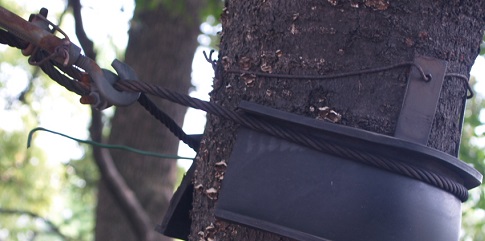
Trees and other garden plants often need extra support, to stop pieces breaking off or becoming damaged or even dangerous. There are a number of reasons for providing support to plants, including:
- To improve safety – large, heavy limbs are potentially hazardous
- To preserve old, valuable trees
- Temporarily support a heavy crop of flowers or fruit
- Support newly planted trees whilst their roots develop
- To support non-clinging climbers
- To train plants into decorative shapes
- To train plants around doorways and windows
- Protect vulnerable plants from wind damage
TOO MUCH ATTENTION IS NOT ALWAYS A GOOD THING
Plants that are well fed and watered tend to grow faster and carry a lot more foliage. Their trunks may be less sturdy and their root system may be poorly developed. They are more likely to blow over in strong winds and their branches are more prone to breaking or tearing under excessive weight.
Luxurious and rampant growth can make a young tree grow taller faster; and a young trunk that has not hardened properly may be supporting a lot of top growth. Without support, this makes it more likely to blow over or snap off in the wind. When this happens you will need to support your plant.
PRUNING PREVENTS PROBLEMS
Most well pruned trees and shrubs will never require extra support. Good pruning will promote a strong structure. A lack of or poor pruning can lead to real problems, creating forked trunks and weak joins in the branches. Without support these plants can be hazardous. Branches are more prone to breaking or tearing under excessive weight and splits can occur in the main trunk of the tree.
TREE SUPPORTS
There are different ways to hold together branches that are in danger of breaking and falling:
- Bracing involves bolting metal rods to prevent two branches from splitting apart.
- Cabling entails attaching a steel cable between two branches so that movement is restricted. This reduces stress on a crotch between the branches, or on the branches themselves.
- Bolting is a technique used for supporting split trunks or branches, and for holding apart limbs that would otherwise rub together.
Note: These are specialist techniques that should be carried out by a qualified arborist. Inserting cables or rods can cause significant damage to the tree and can expose the owner to a greater risk of liability. Always get a qualified tree surgeon, and ask them about their insurance.
DECORATIVE PLANT SUPPORTS
There are plenty of decorative plant supports that will not only provide support for your plants, but are attractive as well:
- Build a pergola around a plant to increase support
- Use decorative tree guards
- If your plant needs cabling, ask your tree surgeon to choose a cable colour that blends in with the surrounding foliage
- Plant your climbers on a lacy ironwork trellis
- Wooden lattice can provide a strong decorative framework for flowering and fruiting climbers
- Train your plants into an Espalier along a wall – it will provide total support for fruit and branches
- Train your shrubs or climbers to grow over a garden arch
- Bend tie wire into heart, star or any other fun shape. Give your shape a stand, then train plants to grow over the shape
TEMPORARY PROPS
Sometimes a branch will sag under the weight of its own fruit and can be in danger of breaking. But if you prune the branch, you will also lose your fruit. You can prop up the branch temporarily using timber logs or metal stakes with padded supports under the branch. Be sure to prune the branch properly after it has finished fruiting.
If you need to use galvanised or other coarse wire to support branches, stems or trunks; place the wire inside an off-cut of hose pipe so that only the hose comes into contact with the plant. This way you will prevent the wire from cutting into the branch and ultimately killing it.
HOW WILL STUDY GET YOU WORK?
Knowledge is More Important than Qualifications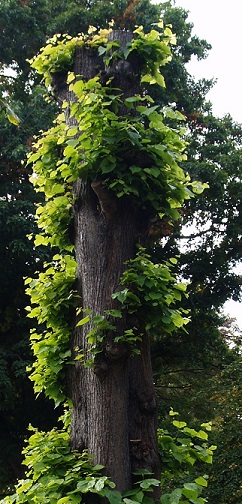
Knowledge is the most important aspect of arboriculture – qualifications come second. This is because it requires a lot of basic horticultural knowledge to care for and maintain trees. Some people may be able to pick up this knowledge by working in horticulture for many years but because arboriculture is so specialised and if you want to be more than a tree lopper you need that fundamental knowledge and doing a course may be the best approach.
Even though knowledge may be more important than a qualification in this industry it is more likely that you will find work if you have that qualification backing you up. It shows that you are serious about your chosen industry and that you are willing to take the right steps to work in the industry and also to keep working within it.
Choosing the right course
Choosing the right course is an important decision for any student, no matter what area of horticulture they are studying for or working within. With this course it combines horticulture basics with arboriculture – this gives you flexibility too and will enable you to move across industry sectors and work in a different field or offer more than one service if you are setting up a business.
A good course should give you more than just facts, it should enable you to gather information but it should also be structured in such a way that you can recall this information even years later. Not all courses do this – especially those that concentrate on competency based learning. Our courses (like many universities) are based on Problem Based Learning – this encourages students to develop problem solving skills and has been found to be the best way to not only gather information but also to be able to retain and recall it. It is not learning by rote!
Our courses have been written by people with years and years of industry experience – they know what you need to know, they also know what the industry wants and also how to encourage and help you to gather those important skills and fundamental knowledge.
Consider Yourself A Professional
Arboriculture, a branch of horticulture, is a specialised field – it is not just a matter of cutting down trees! It is the care and maintenance of trees i.e. tree surgery, tree selection, planting cultivation and production – lopping trees is a last resort.
Safety is also an incredibly important part of arboriculture – it is a high risk industry. Arborists are professionals in their field – if you have a professional attitude towards arboriculture and demonstrate this in interviews then you are more likely to get a job in the field. A professional attitude means that you show prospective employers that you have a sound understanding of the industry, a sound understanding of what arboriculture entails and a professional approach to work.
There is Competition out there
Like any other industry don’t forget that there are many other people competing for the same job – some may have higher qualifications, but if you can confidently prove your skills and knowledge and also have a qualification to back them up - then you will stand out from the crowd.
What Other Skills Should You Have?
- To communicate effectively and efficiently: verbally, in writing and face to face interactions with co-workers, employees and clients.
- Computer skills – today irrelevant of your field of work, it pays to be able to have good IT skills: email, to write up contracts, or send invoices, to keep your tax records or just to inform your clients when you are able to do the work.
- Problem solving skills – this is where we can help you our courses are written around developing problem solving skills so sought after by employers but also important if you are running your own business. Problem solving skills means you can work through all types of situations in a systematic and detailed way.
- Efficiency – this doesn’t mean you have to do things quickly you just need know the best way to approach work. Developing problem solving skills can also help you to be efficient at whatever task you undertake because you are able to look at the situation from several angles and choose the best approach. This is especially important in arboriculture as it is a high risk industry that requires careful planning and thought.
- Know your industry: know who you are competing with, what the industry rates are for the work you are doing, understand the skills required for the work you are undertaking or going to undertake.
- Be passionate about your work – passionate people who can also drive themselves forward, are the most successful in their work. There is a difference between having a ‘passion’ and being a ‘dreamer’ though – dreamers unless they also have tremendous drive rarely do well or stick at anything for long.
- Presentation – always present yourself in the best possible light – that may not mean wearing your ‘Sunday best’ when you are a gardener, but it will mean having a professional approach, being respectful and listening to your clients’ needs or to those of your employer or potential employer. Asking lots of questions and using appropriate language.
BENEFITS OF THIS COURSE
This certificate is unique in that it gives you two employment outcomes - Graduates may pursue career as an arborist or alternatively, as a gardener or horticulturist.
The course is designed to give you a strong foundation for either path. The reason for this is that despite most people starting a course with a clear intention to work as an arborist; other opportunities do arise in horticulture -sometimes more attractive, and sometimes opportunities you may not have even considered when you began your studies. Another reason is that the job of an arborist can often be physically demanding. It is not uncommon for arborists to seek a slight change in their career as they age and their physical abilities diminish. By having a broad based horticulture education, your ability to transition into other horticultural jobs will be easier.
Graduates may enhance their business or career opportunities in many different situations, including:
- Urban horticulture
- Street Tree Management
- Tree removal
- Tree planting
- Tree surgery
- Forestry
- Gardens Management
- Plant Nursery Production
- Parks Management
- Landscaping
- Land Rehabilitation
- Contract pruning
Enrol Now Or
Use our FREE COUNSELLING SERVICE
connect with one of our horticulture tutors
get advice about courses and working in horticulture
Click and Send your Details
ENROL or Use our FREE Course Advice Service to Connect with a Tutor